Search This Blog

Game. Set. Match. Headline Animator

Showing posts with label nadal. Show all posts

Sunday, February 27, 2011

Australian Open Wrap-Up


Djokovic captured the title this year.


The first Grand Slam of this year was all about one person, and one person only.  Novak Djokovic succeeded in finally reclaiming his Australian Open singles title, three years after capturing his first one Down Under.  This was a huge accomplishment in itself, but what was even more incredible was the way in which he ran through the draw, dropping only one set in the process to Ivan Dodig of Croatia.  This "Djokovic" was nothing like the man that won in 2008.  Then, Djokovic was a teenager, prone to unpredictable results, struggling with his serve, and succumbing to nerves.  This time around, the man from Serbia showed his mental fortitude and unbelievable defense throughout the fortnight.

And it's not as if Djokovic's title was a fluke.  He had to fight through constant threats such as Almagro, Berdych, Federer, and Murray.  He also wasn't a favorite coming in.  But Novak powered through these roadblocks without so much as a hiccup. This, in turn, led to his inspirational graduation out of the "One-Slam Wonder" club.

https://blogger.googleusercontent.com/img/b/R29vZ2xl/AVvXsEh66psYM-2YegKJb809r41BvFrZ4m9f4RR7E3h4P3_Ule-hlB9XRMTYIzKL-QF46E_xjvK8XRwnzpQ6ztzk7tQhNwpWPxZUOT3ae85o94Ps4qIu_579Q6LotJEXTm5vnmYx8xBRDKd5Yuw/s400/rafael+nadal+crying+australian+open+2011+injury.jpg
Nadal's exit came to David Ferrer.
Rafael Nadal's quest to become the first man to hold all four majors at once since Rod Laver in 1969 ended in bitter disappointment this year, as he bowed out against the feisty David Ferrer in straight sets.  In a marathon 18+ minute second game, Nadal seemed to have injured his muscle (it was later confirmed to be a small hamstring tear).

From then on, he was nowhere near his best, letting Ferrer dictate the majority of the rallies.  He was out of sorts during the entire 6-4, 6-2, 6-3 beat-down.  Nadal was, as always, classy in defeat.  He congratulated Ferrer continuously in his press conference.  But the lingering question of Nadal's future hangs in the air: How long will it be before his body simply won't be able to support his physically taxing game any longer?

Roger Federer Roger Federer of Switzerland plays a forehand in his second round match against Gilles Simon of France during day three of the 2011 Australian Open at Melbourne Park on January 19, 2011 in Melbourne, Australia.
Federer's forehand let him down.
Roger Federer's Australian Open attempt was not unlike Rafa's.  He came in as a favorite.  And, more importantly, he was dismissed in straight sets.  But the major difference between these conflicting story lines was that Federer appeared to be playing his game.  While Nadal was clearly fighting the effects of a lingering virus and a tear to his hamstring, Federer came in with fine form.  After his U.S. Open semifinal loss to Djokovic, Federer looked nearly invincible for the remainder of last year.  He compiled a 16-2 record with losses only to Andy Murray in Shanghai and to Gael Monfils in Paris.  So no one could be faulted for expecting a final appearance from the Swiss Maestro.  However, things did not turn out to be so clear.  In a tough second round matchup against Gilles Simon of France, Federer became flat up two sets to none.  His forehand began to fall apart, and the match went five sets.  After the grueling match with the Frenchman, Federer's disinterest seemed to continue recurring in his game.  At times when playing Xavier "X man" Malisse, Federer appeared disinterested, making several disastrous errors.  When it really mattered, these little mistakes led to a loss to Djokovic.
http://www1.pictures.zimbio.com/gi/Robin+Soderling+2011+Australian+Open+Day+4+Z7Tjs8N-xFZl.jpg
Soderling had his best Aussie Open to date.

Robin Soderling has never enjoyed relative success at the Australian Open.  Overall, it has been his worst Grand Slam.  This year around, however, everything seemed to be going for him.  He was the highest he'd ever been seeded in a Slam, at 4th, and his draw was considerably favorable.  In his first three  matches, he dominated.  He appeared to be the key person in disrupting the Federer-Nadal dream final.  In a tricky match against the talented Ukrainian, Alexandr Dolgopolov, Robin's serve, which had been his greatest asset the entire tournament, fell apart.  So did his chance to get to the quarterfinals.   He bowed out in five unusually quick sets.  

http://www.ontennis.com/files/images/andy-murray-australian-open2011-02.jpg
Murray was an underdog.
Andy Murray came into the Australian Open without being on the radar.  All the talk was of Nadal's possible Grand Slam and Federer's strong play.  So much focus was put on this possible final that Andy Murray, the finalist exactly a year ago, was not the topic of conversation.  But he came in strong.  His serve was a weapon and his movement was exceptional.  He had straightforward matches at first with players that couldn't really challenge him, like Garcia-Lopez and Jurgen Melzer.  The fact is, Murray was dominating his matches until he came up against the 22-year-old upstart Dolgopolov.  Murray was truly in for a fight.  But he emerged victorious.  By the semifinals, the draw had opened up with Nadal's elimination.  And so, the light had again turned to Murray.  With this new pressure on his shoulders, Andy struggled with the force of Ferrer's play, and played much of the match from far behind the baseline.  He came within a point of being two sets down to love.  Somehow, he pulled out the victory 4-6, 7-6, 6-1, 7-6.  Once again though, his passive game showed through when he played the final.  Djokovic didn't give Andy even the slightest of openings, unlike his previous opponents.  His anger eventually got the best of him, and it was a highly unsatisfying performance.

And so, another Australian Open has come and gone.  Many twists and surprising results dotted the field.  Newcomers emerged, stars bowed out, and five-setters dominated the field. The tournament has left us all in eager anticipation for the next Grand Slam, Roland Garros.

Is it really another four months until then?

Sunday, February 20, 2011

Muscular Endurance: Viable or Not?

Upon the completion of the fortnight Down Under, an interesting article caught my eye at http://atpworldtour.com/ (for reference: "For Great Court Coverage, Build Muscular Endurance").  As a fitness fanatic and avid tennis player, I was immediately interested.  The article posed Novak Djokovic as its poster-boy, and attributed his recent success to muscular endurance as the key factor in his defensively oriented game.

After finishing the article, I took it upon myself to do some research.  What I gathered was a definitive classification of the different types of muscle training.  Muscle training can be classified into three generally distinct groups:
  • Muscular Strength Training
  • Muscular Explosiveness Training
  • Muscular Endurance Training
Muscular endurance training is rare in tennis.  It is designated by the ability of a muscle to repeat the same motion over and over for a long period of time.  For a professional match, it can last for over five hours.  The simplest form of muscular endurance is a completion of the unit turn and bend that is necessary before every forehand and backhand.  A more advanced form of muscular endurance includes the capability to reproduce the same explosive bursts of energy to chase down balls and drop shots continuously throughout a long match.

On a general level, athletes tend to focus on muscular strength over other types of fitness.  Usually, it is caused by ignorance or by trying to build a stronger foundation.  Muscular explosiveness and muscular endurance training can only be effective after a athlete develops a strong base.  Specifically for tennis players, muscular explosiveness training constitutes one of the most, if not the most important sector of tennis.  At the professional level, however, the combination of the three forms of fitness tends to parallel success.

Most players focus solely on the muscular strength aspect of the game in an effort to keep up with the multitude of power on tour.  But top players understand the importance of muscular strength training and muscular explosiveness training, and implement both into regular workouts.

Gael Monfils Gael Monfils of France returns a shot to Rafael Nadal of Spain during day nine of the 2009 U.S. Open at the USTA Billie Jean King National Tennis Center on September 8, 2009 in the Flushing neighborhood of the Queens borough of New York City.
Monfils returns a forehand against Nadal at the U.S. Open.
People often question what separates a top twenty player from a top five player.  Top  twenty players all have big weapons and promising talent.  But the players who can go the distance while maintaining a high standard of play day in and day out are the champions that dominate the game.  A great example of this was Rafael Nadal's 2009 U.S. Open match against Gael Monfils of France.  Both players are well-known for their incredible athleticism and are probably the most physically defined people on tour.  After a set of extreme rallies and unprecedented movement, Gael Monfils took the first set in a tiebreak.  Nadal may have run just as much as the Frenchmen, if not more, and still won the match.
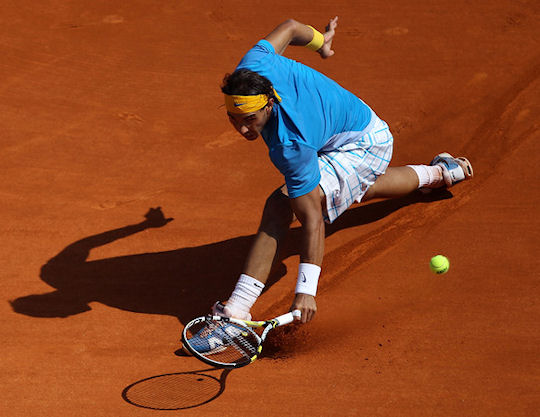
Rafael Nadal displaying his muscular endurance.
Monfils, however, was the one who physically broke down.  The next three sets were a beat-down due to Monfils' inability to match Rafael Nadal's physicality.  So why didn't Nadal's game drop as Monfils' did?  The answer lies in muscular endurance training.  Rafael Nadal was able to outlast his opposition because he has maxed out his muscular endurance.  Top players like Roger Federer, Andy Murray, and Novak Djokovic all have the capability to play five sets through the seven rounds of a Grand Slam, and still become champions because of their muscular endurance.

You may be questioning how you can train your muscular endurance.  You may already be training without knowing it!  Exercising on the treadmill, elliptical, or stair-master are all perfect ways to increase your muscular endurance.  If you want great results on the court, doing exercises such as lunges and squats are very helpful (any exercise in reality can be used).  The important thing is doing high reps with smaller weights.  Keeping your shoulders and core strong is also key to diminishing the number of injuries you get while playing.  These high repetition workouts teach your muscles how to stay strong and last long on the court during those grueling matches!

Thursday, February 10, 2011

Australian Open Wrap-Up


Djokovic captured the title this year.
The first Grand Slam of this year was all about one person, and one person only.  Novak Djokovic succeeded in finally reclaiming his Australian Open singles title, three years after capturing his first one Down Under.  This was a huge accomplishment in itself, but what was even more incredible was the way in which he ran through the draw, dropping only one set in the process to Ivan Dodig of Croatia.  This "Djokovic" was nothing like the man that won in 2008.  Then, Djokovic was a teenager, prone to unpredictable results, struggling with his serve, and succumbing to nerves.  This time around, the man from Serbia showed his mental fortitude and unbelievable defense throughout the fortnight.

And it's not as if Djokovic's title was a fluke.  He had to fight through constant threats such as Almagro, Berdych, Federer, and Murray.  He also wasn't a favorite coming in.  But Novak powered through these roadblocks without so much as a hiccup. This, in turn, led to his inspirational graduation out of the "One-Slam Wonder" club.

https://blogger.googleusercontent.com/img/b/R29vZ2xl/AVvXsEh66psYM-2YegKJb809r41BvFrZ4m9f4RR7E3h4P3_Ule-hlB9XRMTYIzKL-QF46E_xjvK8XRwnzpQ6ztzk7tQhNwpWPxZUOT3ae85o94Ps4qIu_579Q6LotJEXTm5vnmYx8xBRDKd5Yuw/s400/rafael+nadal+crying+australian+open+2011+injury.jpg
Nadal's exit came to David Ferrer.
Rafael Nadal's quest to become the first man to hold all four majors at once since Rod Laver in 1969 ended in bitter disappointment this year, as he bowed out against the feisty David Ferrer in straight sets.  In a marathon 18+ minute second game, Nadal seemed to have injured his muscle (it was later confirmed to be a small hamstring tear).

From then on, he was nowhere near his best, letting Ferrer dictate the majority of the rallies.  He was out of sorts during the entire 6-4, 6-2, 6-3 beat-down.  Nadal was, as always, classy in defeat.  He congratulated Ferrer continuously in his press conference.  But the lingering question of Nadal's future hangs in the air: How long will it be before his body simply won't be able to support his physically taxing game any longer?

http://www.thenational.ae/deployedfiles/Assets/Richmedia/Image/SaxoPress/AD20110103869481-Roger%20Federer%20r.jpg
Federer's forehand let him down.
Roger Federer's Australian Open attempt was not unlike Rafa's.  He came in as a favorite.  And, more importantly, he was dismissed in straight sets.  But the major difference between these conflicting story lines was that Federer appeared to be playing his game.  While Nadal was clearly fighting the effects of a lingering virus and a tear to his hamstring, Federer came in with fine form.  After his U.S. Open semifinal loss to Djokovic, Federer looked nearly invincible for the remainder of last year.  He compiled a 16-2 record with losses only to Andy Murray in Shanghai and to Gael Monfils in Paris.  So no one could be faulted for expecting a final appearance from the Swiss Maestro.  However, things did not turn out to be so clear.  In a tough second round matchup against Gilles Simon of France, Federer became flat up two sets to none.  His forehand began to fall apart, and the match went five sets.  After the grueling match with the Frenchman, Federer's disinterest seemed to continue recurring in his game.  At times when playing Xavier "X man" Malisse, Federer appeared disinterested, making several disastrous errors.  When it really mattered, these little mistakes led to a loss to Djokovic.
http://www1.pictures.zimbio.com/gi/Robin+Soderling+2011+Australian+Open+Day+4+Z7Tjs8N-xFZl.jpg
Soderling had his best Aussie Open to date.

Robin Soderling has never enjoyed relative success at the Australian Open.  Overall, it has been his worst Grand Slam.  This year around, however, everything seemed to be going for him.  He was the highest he'd ever been seeded in a Slam, at 4th, and his draw was considerably favorable.  In his first three matches, he dominated.  He appeared to be the key person in disrupting the Federer-Nadal dream final.  In a tricky match against the talented Ukrainian, Alexandr Dolgopolov, Robin's serve, which had been his greatest asset the entire tournament, fell apart.  So did his chance to get to the quarterfinals.   He bowed out in five unusually quick sets.  

http://www.ontennis.com/files/images/andy-murray-australian-open2011-02.jpg
Murray came in as an underdog.
Andy Murray came into the Australian Open without being on the radar.  All the talk was of Nadal's possible Grand Slam and Federer's strong play.  So much focus was put on this possible final that Andy Murray, the finalist exactly a year ago, was not the topic of conversation.  But he came in strong.  His serve was a weapon and his movement was exceptional.  He had straightforward matches at first with players that couldn't really challenge him, like Garcia-Lopez and Jurgen Melzer.  The fact is, Murray was dominating his matches until he came up against the 22-year-old upstart Dolgopolov.  Murray was truly in for a fight.  But he emerged victorious.  By the semifinals, the draw had opened up with Nadal's elimination.  And so, the light had again turned to Murray.  With this new pressure on his shoulders, Andy struggled with the force of Ferrer's play, and played much of the match from far behind the baseline.  He came within a point of being two sets down to love.  Somehow, he pulled out the victory 4-6, 7-6, 6-1, 7-6.  Once again though, his passive game showed through when he played the final.  Djokovic didn't give Andy even the slightest of openings, unlike his previous opponents.  His anger eventually got the best of him, and it was a highly unsatisfying performance.

Another Australian Open has come and gone.  Many twists and surprising results dotted the draw.  Newcomers emerged, stars bowed out, and five-setters dominated the field. The tournament has left us all in eager anticipation for the next Grand Slam, Roland Garros.

Is it really another four months until then?  Sigh...